Natural and reclaimed slate roofing across Horsham and West Sussex. Welsh slate, Horsham stone and Spanish slate. New roofs, repairs and conservation area work.
Tell us the job in 30 seconds. No pushy sales, no call-out fee.
📞 Call Now: 0140 358 1272Horsham has a particular connection with natural stone roofing. Horsham Stone — a local sandstone that splits naturally into thin layers — was historically the primary roofing material for properties throughout the Low Weald, and many period buildings in Horsham town centre and the surrounding villages retain original Horsham Stone roofs. Alongside this, natural Welsh slate is the appropriate specification for Victorian and Edwardian properties in the town centre conservation area.
Natural slate is the longest-lived roofing material we install — properly maintained, a Welsh slate roof will outlast the building it covers. The 80–100 year lifespan significantly outperforms concrete tile (40–60 years) and makes the higher initial cost economically justified for most period Horsham properties.
Horsham Stone is no longer commercially quarried. All repairs and replacements require reclaimed stone sourced from demolition, specialist salvage networks, or other roofers working in the area. We maintain access to reclaimed Horsham Stone stocks through a specialist salvage network and can source appropriate stone for repairs before quoting — we confirm the match before starting work, not after. The colour, thickness and texture of Horsham Stone varies significantly between sources, and matching for repairs requires expertise and comparison with existing material.
Welsh slate from the Penrhyn, Dinorwic and Ffestiniog quarries is the standard specification for Victorian and Edwardian properties in Horsham's conservation areas. It is still commercially available, though prices have risen significantly. For properties where Welsh slate is specified by planning authority or simply appropriate, we source from UK quarries and can provide certification of origin. We do not substitute Chinese or Spanish slate without explicit discussion of the differences.
Individual slate replacement requires matching the original in size, thickness, colour and type. Incorrect size creates differential loading and water shedding problems. Incorrect thickness creates gaps that allow wind-driven rain to penetrate. We identify the correct specification before ordering and carry a range of the most common Welsh slate profiles on the van for emergency repairs on Horsham period properties.
📞 Free Survey — No Call-Out Fee — Call 0140 358 1272 to arrange a free, no-obligation survey anywhere in Horsham and West Sussex.
All prices include labour, materials and VAT. Written fixed-price quotes provided for all work. Free surveys with no call-out fee.
Individual slate replacement. Price includes correct slate, copper nails and labour.
Replacing a section. Material and labour. Welsh slate specification.
Full re-roof in Welsh slate. Significantly higher material cost vs concrete tile.
Reclaimed stone sourced to match. Survey required before quotation.
Based in Horsham. Not a franchise farming leads to subcontractors — our team on every job.
No call-out fee anywhere in Horsham or West Sussex. Written quote before we start.
Written workmanship guarantee on all work. We stand behind every job.
£5m public liability insurance. Fully insured on every job.
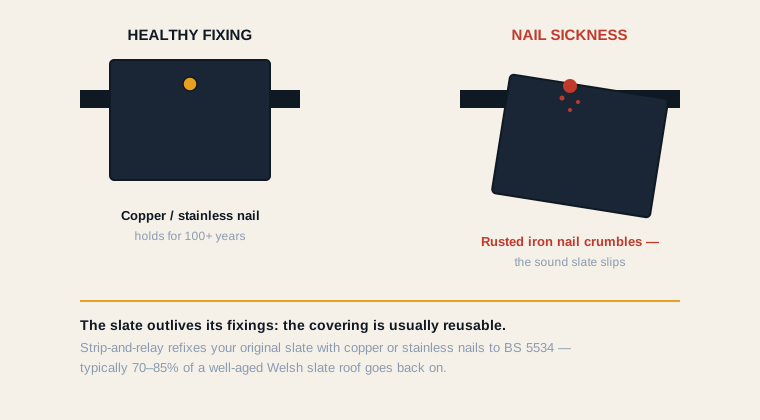
Slate outlives its fixings. On the town’s Victorian and Edwardian stock the slate is usually fine - the nails holding it are not.
When it is not the answer: A handful of slipped slates with sound fixings elsewhere is a repair; but once tingles multiply across a slope, nail sickness has arrived and strip-and-relay - reusing your original slate - beats endless patching. Read the full guide.
We assess the slate itself (usually reusable Welsh slate) separately from the fixings (usually the problem) - it changes the price dramatically.
Repair, partial relay or full strip-and-relay priced separately, with salvage credit for sound slate stated.
Slates lifted carefully, sorted and stacked - typically 70-85% reusable on a well-aged Welsh slate roof.
New breathable membrane, treated battens, slates re-fixed with copper or stainless nails to BS 5534 - the fixings that should have been used a century ago.
Matching reclaimed slate makes up shortfall, ridges re-bedded, guarantee handed over.
| Job | Typical duration |
|---|---|
| Slipped slate refix (few) | Half day |
| Tingle repairs across a slope | 1 day |
| Partial relay (one slope) | 3-5 days |
| Full strip-and-relay (terrace) | 8-12 days |
Slate work is weather-sensitive at strip stage only - once felted, relay proceeds in most conditions.
Slate repairs run from roof ladders; relays are fully scaffolded like any re-roof. Scaffold is specified for: partial and full relays, and any conservation-street frontage - always itemised in your written quote, never a hidden extra, and we arrange it.
The Causeway and Denne Road conservation streets take footway scaffold licences with conservation conditions, while the Victorian terraces off Park Street and New Street often need rear-lane tower access rather than front scaffold. Pavement scaffold and skip permits go through Horsham District Council; allow a few working days on streets like The Causeway, East Street, Park Street where space is tight.
| Job | Typical range | Notes |
|---|---|---|
| Slipped slate refix (few) | £150-£300 | Copper tingles or hooks |
| Tingle repairs across slope | £300-£600 | Holding measure, honestly stated |
| Partial relay (one slope) | £3,500-£6,500 | Reusing sound slate |
| Full strip-and-relay, terrace | £10,000-£16,000 | 70-85% slate reuse typical |
| Matching reclaimed slate supply | Market rate | Sourced and matched |
Worked example: One slope of an Edwardian villa near Horsham station: stripped, 78% of the Welsh slate reused, relaid on breathable membrane with copper nails, £5,400 over four days.
Relays staged like any re-roof - scaffold-up, mid-point, completion. Nothing before materials on site.
Covering RH12, RH13 and surrounding postcodes.
Relaid slate carries the 10-year workmanship guarantee - and copper-nailed Welsh slate realistically gives another 80-100 years of service.
If a fault appears in covered work, we come back and put it right. No quibbling, no re-charge.
A relay is re-roof-scale disruption - scaffold, skip, and the distinctive clink of slate handling - but the finished roof is the original, done right. You do not need to stay home for external work - we just need power and access agreed in advance.
Stripped areas are felted same-day so the roof never sleeps open - winter relays just carry a wider margin. Horsham sits in the damp Low Weald, so autumn drying times run slow and moss pressure is constant on north pitches.
"Victorian house with original Horsham Stone roof. They sourced matching reclaimed stone for the repairs and the result is invisible. Excellent craftsmanship."
"Full re-roof in Welsh slate on our Edwardian property. They understood the conservation area requirements and specified correctly. Outstanding result."
"Slate repairs after storm damage. They identified the correct slate profile and had matching material. Clean repair, no leaks."
Natural slate is one of the longest-lasting roof coverings there is: Welsh slate lasts 80–150 years, and often it’s the nail fixings that fail before the slate itself. That’s why on Horsham’s Victorian and Edwardian terraces a careful strip-and-relay, reusing the sound original slate on new fixings, can be more appropriate than a full replacement. Concrete tile, by comparison, lasts 40–60 years. The long life is exactly why slate justifies its higher upfront cost on period property. Our guide to how long a roof lasts compares all the common coverings.
Yes — we source reclaimed Horsham Stone through established salvage networks for repairs and re-roofing. It hasn’t been quarried commercially for decades, so all Horsham Stone work relies on reclaimed material, sorted and graded to match your existing roof for size, thickness and weathering. Because sourcing takes time and the stone is heavy, skilled work laid in diminishing courses, it’s priced per specification following survey rather than by a standard rate. It’s a defining material of the district’s conservation areas — our heritage roofing page covers it in full.
For lifespan and appearance on a period property, yes — natural slate lasts two to three times as long as concrete tile and is the correct, often consent-required material on Victorian, Edwardian and conservation properties. But it costs 2.5–3 times as much in materials and takes longer to lay, so on a modern estate house where concrete tile is the appropriate covering, slate would be over-specification. The right answer depends on the property: slate for period and heritage stock, concrete or clay tile for post-war homes. Our tile vs slate comparison weighs it up in detail.
Re-roofing like-for-like in slate on a property that already has a slate roof is generally permitted development. But changing to slate from another material, or any roof work on a listed building or within certain conservation areas, can require consent from Horsham District Council — and on listed buildings, slate type and detailing are often specified. Since slate is common on exactly the period and conservation stock where consent applies, it’s worth checking. We confirm what’s needed during the survey. Our planning permission guide and conservation area guide cover the rules.
On slate roofs it’s usually the nails that fail first while the slate itself is still sound — so slipped or missing slates often mean re-fixing rather than replacing. Signs that point to a repair: isolated slipped slates, a few missing ones, individual cracked slates. Signs that point to a fuller job: widespread slippage across the roof (‘nail sickness’ in the slate nails), delaminating or flaking slates, or a roof that’s been patched repeatedly. We assess honestly at survey — a careful strip-and-relay reusing sound slate is often better value than full replacement. See signs you need a new roof.
Horsham Stone is a local Wealden sandstone that splits into thick, heavy grey-brown slabs, giving the district’s oldest buildings their distinctive steep, characterful roofscape. It was quarried locally for centuries but isn’t produced commercially any more, so repairs and re-roofing rely on reclaimed stone from salvage. It’s laid in diminishing courses — larger slabs at the eaves, smaller toward the ridge — on stout timbers built to carry the weight. It’s one of the defining heritage materials of the Horsham conservation areas, and matching it correctly is specialist work. See our heritage roofing page.
It’s best avoided where visible. Different slate types — Welsh, Westmorland, Spanish, or reclaimed versus new — vary in colour, thickness and texture, so mixing them on the same visible slope looks patchy and can affect a period property’s appearance and value. For repairs we identify your existing slate type and source matching material so the repair blends in. Where an exact match genuinely isn’t available, we discuss options with you rather than fitting an obvious mismatch. On a hidden slope or outbuilding the constraint relaxes, but on a prominent period roof, matching matters.