⚡ Emergency roof repairs available 24/7 — Call now: 0140 358 1272
⭐ 4.9/5 · 127 Reviews · Lead Specialists

Leadwork & Flashings Horsham

Lead flashing installation and replacement across Horsham and West Sussex. Chimney flashings, valleys, abutments and bay windows. Correctly specified and fixed.

Tell us the job in 30 seconds. No pushy sales, no call-out fee.

📞 Call Now: 0140 358 1272
20+
Years Local
127
5★ Reviews
24/7
Emergency
10yr
Guarantee
What does leadwork cost in Horsham? A new lead flashing set costs £400–£900 and valley relining £500–£1,200. We specify Code 5 minimum with patination oil as standard for West Sussex conditions. Free survey with no call-out fee — call 0140 358 1272.
✓ NFRC Registered
✓ Fully Insured
✓ 10-Year Guarantee
✓ Free Quotes
✓ No Hidden Costs
All Roofing Services
Roof Repairs Roof Replacement Flat Roofing Guttering Chimney Repairs Emergency Fascia & Soffits Moss Removal Velux Windows Leadwork Slate Roofing Surveys

Leadwork & Flashings Horsham

Lead is the most durable roofing material available — correctly installed sheet lead lasts 50–100 years. It is also the most commonly specified incorrectly. The majority of lead flashing failures we attend in Horsham are the result of original installation defects rather than material age: flashings that were surface-fixed with mastic rather than stepped into the mortar joints, lead that was too thin for the application, or detailing that was compromised by the original installer to save time.

Horsham's damp Low Weald climate accelerates lead corrosion compared to drier UK locations. Valley lead on properties near the Southwater Country Park and Arun Valley properties in Pulborough show measurably faster surface oxidation than equivalent installations in more sheltered positions.

Code Weight — Why It Matters

Lead sheet comes in code weights from Code 3 to Code 8, where the code number indicates the thickness in kg/m². Different applications require different code weights: Code 4 for soakers and stepped flashings, Code 5 for valley liners and chimney back gutters, Code 6 or higher for wide valley gutters and large flat areas. Specifying too-thin lead in high-water-flow applications is the single most common leadwork installation error. We specify code weight correctly for every application.

Stepped Flashing vs Mastic — The Permanent Fix

Lead flashing at a chimney or abutment should be stepped into the mortar joints — cut and wedged into the masonry bed, then pointed over with mortar. This creates a mechanical fix that lasts as long as the lead itself. Mastic-applied flashings are a temporary repair that typically lasts 2–5 years before UV degradation causes failure. We do not carry out mastic flashing repairs. If the correct fix is more expensive than the customer expected, we explain why and let them make an informed decision.

Lead Valley Installation

Valley liners in lead are the most demanding leadwork application on a domestic roof. The liner must be lapped correctly, the wing dimension must be sufficient to prevent water from riding over the edge in heavy rain, and the joints must be lapped in the direction of flow. Valley lead in Horsham also needs to account for the higher autumn and winter rainfall rates in the Low Weald — valleys sized for a drier climate will overflow during West Sussex winter storms.

📞 Free Survey — No Call-Out Fee — Call 0140 358 1272 to arrange a free, no-obligation survey anywhere in Horsham and West Sussex.
Pricing Guide

Typical Costs in Horsham — 2026

All prices include labour, materials and VAT. Written fixed-price quotes provided for all work. Free surveys with no call-out fee.

Chimney flashing (full set)

£400–£900

Step flashing, back gutter and soakers. Correctly stepped and fixed into mortar joints.

Abutment flashing

£250–£600

Wall-to-roof junction. Stepped and wedged. Price depends on length.

Valley relining (lead)

£600–£1,400

Full valley strip and reline with code 5 lead. Includes surrounding tile relay.

Bay window leadwork

£300–£700

Bay roof lead replacement. Complex detailing, includes all flashings.

Why Choose Us

Horsham's Most Trusted Roofers

Genuinely Local

Based in Horsham. Not a franchise farming leads to subcontractors — our team on every job.

Free Surveys

No call-out fee anywhere in Horsham or West Sussex. Written quote before we start.

10-Year Guarantee

Written workmanship guarantee on all work. We stand behind every job.

NFRC Registered

£5m public liability insurance. Fully insured on every job.

Honest advice

Do You Actually Need Leadwork & Flashings?

Lead is where the roof meets everything else - chimneys, walls, windows, valleys - and it is where most “roof” leaks actually start.

When it is not the answer: If existing lead has simply lifted in wind but is the right code and undamaged, re-dressing and re-fixing it is the honest repair - full renewal is for thinned, split or under-specified lead. Read the full guide.

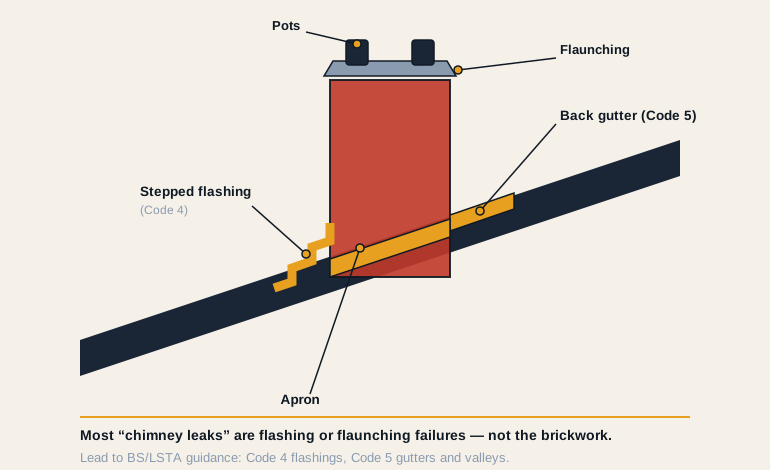
Chimney lead flashing detail: flaunching, pots, stepped flashing, apron and back gutter
Chimney weatherproofing — most “chimney leaks” are flashing or flaunching failures.
The process

How a Horsham Leadwork & Flashings Job Runs

1. Survey

Every abutment, valley and flashing checked - and the lead’s code (thickness) assessed, because under-code lead fails early no matter how well fitted.

2. Written quote

Code 4 for flashings, Code 5 for valleys and gutters as standard - to Lead Sheet Training Academy guidance, with patination oil on new work.

3. The work

Old lead out, chases cleaned and re-cut where needed, new lead dressed in proper lengths with expansion joints - long single runs are why cheap leadwork splits.

4. Pointing

Chases repointed - lime on old masonry, appropriate mortar on modern - never mastic smeared over the job.

5. Sign-off

Water-path checked, photos, guarantee handed over.

See the full walkthrough of how we work →

Timescales

How Long Does It Take?

JobTypical duration
Chimney flashing renewal1 day
Valley re-lay (per valley)1-2 days
Bay window topHalf to 1 day
Abutment flashing run1 day

Lead dresses best in mild weather - hard cold makes it stiff and workmanship suffers, so deep-winter lead jobs pick their days.

Access

Access, Scaffolding & Permits in Horsham

Flashing work runs from towers and roof ladders; chimney lead needs the same proper platform as any stack work. Scaffold is specified for: chimney flashings and any valley work - proper standing access is what makes lead last - always itemised in your written quote, never a hidden extra, and we arrange it.

The Causeway and Denne Road conservation streets take footway scaffold licences with conservation conditions, while the Victorian terraces off Park Street and New Street often need rear-lane tower access rather than front scaffold. Pavement scaffold and skip permits go through Horsham District Council; allow a few working days on streets like The Causeway, East Street, Park Street where space is tight.

Pricing

Leadwork & Flashings Prices in Horsham

JobTypical rangeNotes
Chimney flashing set£400-£900Code 4, patination oiled
Valley re-lay (per valley)£500-£1,200Code 5
Bay window top£350-£700Code 4/5
Abutment run£300-£650Per elevation
Re-dress & re-fix existing£150-£350Where lead is sound

What moves the price

Worked example: A leaking stepped flashing where a Park-area Victorian terrace meets its neighbour: renewed in Code 4 with proper expansion laps and lime-pointed chases, £620 in a day.

Payable on completion for single-day jobs; valleys staged where part of larger works. No deposits.

Covering RH12, RH13 and surrounding postcodes.

Guarantee

The Guarantee in Plain Terms

New leadwork carries the 10-year workmanship guarantee - and properly specified lead to LSTA guidance realistically outlasts the guarantee several times over.

If a fault appears in covered work, we come back and put it right. No quibbling, no re-charge.

Good to know

What It Is Like While We Work

A day or two of quiet, careful work - lead is hand-dressed, not hammered - with minimal debris and the odd mortar bucket. You do not need to stay home for external work - we just need power and access agreed in advance.

Lead itself shrugs off weather - it is the mortar chases that need dry curing time, so pointing days are chosen with the forecast. Horsham sits in the damp Low Weald, so autumn drying times run slow and moss pressure is constant on north pitches.

Customer Reviews

What Horsham Customers Say

★★★★★

"Victorian house with failing chimney flashings that had been mastic-patched for years. Finally had them done properly — stepped and fixed correctly. No more leaks."

G. Norris · The Causeway, Horsham
★★★★★

"Lead valley on our 1930s property replaced. They found the original was the wrong code weight. New installation is correct spec. Thorough and professional."

H. Fielding · Billingshurst
★★★★★

"Abutment flashing on a rear extension replaced. Clean work, competitive price, properly fixed into the masonry."

I. Partridge · Storrington
FAQ

Frequently Asked Questions

Correctly specified and installed lead flashing lasts 50 years or more — it’s one of the most durable materials on a roof when done properly. We use Code 5 lead as a minimum for flashings and valleys, hand-dressed to shape and treated with patination oil so it weathers evenly. What fails early is the wrong approach: under-spec lead, over-long pieces that split from thermal movement, or the mortar-and-mastic ‘flashing’ some firms use instead of proper lead, which cracks within a few winters. Done to standard, lead outlasts most other roof components. See Code 5 lead in our glossary.

Almost never. A leak at the chimney is usually the flashing — the lead that seals the junction between the stack and the roof — rather than the chimney itself, and renewing the flashing solves it without touching the masonry. Old mortar-based fillets crack and let water track behind them; proper stepped lead flashing with soakers, dressed into the brickwork, seals it permanently. Occasionally the stack also needs repointing while we’re there, but that’s a separate, minor job. Our chimney repairs page covers stack work if it’s needed alongside the flashing.

Sometimes — if a single section has lifted or a joint has opened but the lead is otherwise sound and correctly specified, a targeted repair is viable. But where the lead is under-spec, split from thermal movement, or was fitted as one over-long piece (a common cause of failure), replacement of that run in correctly-sized Code 5 lead is the lasting fix. We assess honestly: patching failing leadwork just brings you back to the same problem. Where it’s a mortar-and-mastic ‘repair’ someone did instead of proper lead, that always needs redoing properly.

A new lead flashing set around a chimney or abutment costs £400–£900 depending on the size of the stack and access; valley relining in lead runs £500–£1,200. A localised flashing repair is less. The cost reflects the lead itself (Code 5 is a substantial material), the hand-dressing skill involved, and scaffold or access. It’s more than a mastic smear, but it lasts 50 years rather than two or three, so it’s far better value over time. We itemise the leadwork clearly in the quote rather than bundling it into a vague figure.

Patination oil is a treatment applied to new lead immediately after installation, and yes — it matters, especially in exposed and coastal parts of West Sussex. New lead reacts with rainwater to form white carbonate staining that washes down and marks the masonry, tiles or render below. Patination oil prevents this initial reaction, letting the lead weather to its natural even grey without staining the surfaces beneath. It’s a standard part of a proper leadwork job — skipping it is a sign of a rushed installation, because the staining it prevents is unsightly and hard to remove afterwards.

We source Code 5 (and heavier where specified) lead from established roofing merchants, ensuring it meets BS EN 12588, the British and European standard for rolled lead sheet. What matters more than where it’s bought is that it’s the correct code (thickness) for the job — Code 5 minimum for valleys and flashings, heavier for larger or more exposed work — and that it’s installed to the Lead Sheet Association’s detailing guidance. Under-spec lead is a common corner-cut that fails early. We specify and install to standard, which is what makes leadwork last.

Signs a lead valley is failing include water staining on ceilings below the valley line, visible cracks or splits in the lead (often from thermal movement where over-long pieces were used), lead that’s become thin or brittle, and debris trapping water because the valley has distorted. Valleys backing onto trees — common near St Leonard’s Forest — fail sooner because trapped leaf litter holds water against the lead. If you can see the valley from a window or the ground and it looks cracked, rippled or patched, it’s worth a survey. Relining in correctly-sized Code 5 lead is the lasting fix.

Areas We Cover

Covering Horsham & West Sussex

Horsham Southwater Billingshurst Pulborough Storrington Henfield Crawley Burgess Hill

Lead Specification for West Sussex Conditions

West Sussex's relatively damp Low Weald climate creates conditions that accelerate lead surface oxidation compared to drier UK regions. Properties near Horsham's waterways — the Arun tributaries around Pulborough and Billingshurst — show measurably faster surface bloom development than town centre properties. For all our leadwork in Horsham and West Sussex, we specify patination oil application as standard to accelerate natural passivation and prevent white carbonate staining on new installations.

Code weight specification is the most commonly incorrect element of leadwork on Horsham properties. Lead installed in the 1970s–90s frequently used Code 3 sheet in valley and flashing applications where Code 5 is the correct minimum. Code 3 lead in a valley gutter carrying West Sussex winter rainfall volumes fails through fatigue cracking faster than its theoretical design life. When we replace valley liners in Horsham, we specify Code 5 minimum — not Code 3 because it is cheaper.

We carry out free surveys across Horsham and West Sussex — no call-out fee, written quote before any work starts. All work carries a written 10-year workmanship guarantee. NFRC registered, £5 million public liability insurance. Call 0140 358 1272 to arrange a survey, or use the contact form below. We typically schedule within 3–5 working days. Emergency call-outs attended within 2–4 hours for active leaks and storm damage across all of West Sussex.

Get In Touch

Free Leadwork & Survey — Horsham

No call-out fee. No obligation. Free written quote from a local Horsham specialist.

0140 358 1272 About Horsham Roofing Experts