When more than around 40% of fixings have failed, systematic re-nailing costs approach a full re-roof, making replacement the better value option. — NFRC technical guidance
What Is Nail Sickness?
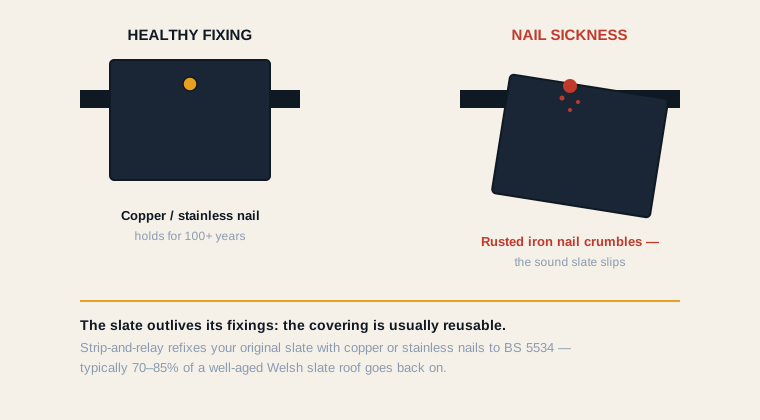
Nail sickness is the gradual corrosion of the nails that fix roof tiles to their battens. As the nails rust and weaken over decades, they lose their grip on the tile. The tile then relies only on gravity and the tile above it to stay in place — until a gust of wind or a hard frost causes it to slip, crack or fall entirely.
It's not dramatic. It doesn't happen overnight. But on a roof with widespread nail sickness, a single windy autumn can send dozens of tiles sliding — and each one that falls is a gap in your roof's waterproof layer.
Why Is Nail Sickness Common in Horsham?
Horsham's housing boom of the 1960s and 70s produced thousands of properties across Roffey, Littlehaven and Broadbridge Heath with concrete interlocking tile roofs fixed with steel nails. Those nails are now 40–60 years old. Steel corrodes. The maths is simple: the roofs built across Horsham in that era are entering the period of maximum nail sickness risk right now.
The Low Weald's damp climate doesn't help. Persistently wet winters accelerate the corrosion cycle compared to drier inland locations, and the humidity created by the surrounding woodland means Horsham's concrete tile roofs see more freeze-thaw cycles in winter than you might expect from a town this far south.
How To Tell If Your Roof Has Nail Sickness
You can't see nail corrosion from the ground, but you can see its symptoms. The most reliable ground-level check: look at your roof after a windy night. Slipped tiles — tiles that have dropped two or three centimetres out of alignment — are the first visible sign. They'll appear as misaligned tiles in an otherwise regular course.
- Tiles slipping regularly without obvious impact damage
- Loose tiles that lift easily when tested by hand from a ladder
- Tiles resting rather than sitting firmly in the interlocking profile
- Previous slip repairs visible — mismatched replacement tiles scattered across the roof
- Ridge tiles that rock or move when touched
- Moss growth obscuring the surface — moss retains moisture and accelerates nail corrosion below it
A proper diagnosis requires a roof inspection. From ground level you can spot symptoms; a roofer on the roof can physically test individual tiles and assess the true extent of nail failure across the surface.
Repair or Replace?
This is the key question, and the honest answer depends on the extent of the nail failure across your roof.
When Repair Makes Sense
If nail sickness is confined to one slope or one section — perhaps 15–20% of the overall roof area — re-nailing the affected tiles and replacing those that have cracked is a reasonable option that buys another 5–10 years. This is most applicable on roofs where the overall tile condition is still sound and the felt beneath is intact.
When Replacement Is the Right Call
When nail failure is widespread — affecting more than 30–40% of the tile fixing across the roof — repair becomes uneconomical. You'd be spending significant money on labour to re-nail individual tiles on a roof that will continue presenting the same problem across the remaining area. A full replacement with new tiles, underlay and battens solves the problem permanently and comes with a 10-year guarantee. It's also the right time to address the felt, which on a 1970s Horsham roof is likely beyond its design life regardless of what the tiles look like.
If your property is a concrete-tiled house built in Roffey, Littlehaven or Broadbridge Heath between 1960 and 1985, and you haven't had a roof inspection in the last five years, it's worth getting one. Not because something is necessarily wrong — but because nail sickness at 15% extent is a repair; at 60% extent it's an emergency and a more expensive replacement.
What Happens If You Ignore It?
Left untreated, widespread nail sickness leads to: accelerating tile loss during winter storms, water ingress into the roof structure, felt failure accelerated by the freeze-thaw cycle, and eventually structural damage to battens and rafters from persistent damp. What starts as a £1,500 re-nailing job becomes a £7,000 full replacement — and potentially a £10,000+ replacement if the underlying timber structure has been damaged by water over several years.
Concerned About Nail Sickness?
We inspect and diagnose roof nail sickness across Horsham and West Sussex. Free survey, honest assessment, no obligation.
📞 Book a Free InspectionLast reviewed: July 2026 by Horsham Roofing Experts.
The repair-or-replace decision, estate by estate
The single question every homeowner with nail sickness wants answered is whether to repair or re-roof, and the honest answer is a percentage. Below roughly 40% of tiles affected, targeted re-fixing is good value and we’ll recommend it. Above 40%, systematic re-nailing approaches the cost of a full re-roof while leaving the remaining original nails to keep failing — so a re-roof becomes the better investment. The reason this matters so much in Horsham is that whole estates were built at once, so when nail sickness arrives, it arrives across a roof more or less together.
On the 1960s–70s concrete-tile estates — much of Roffey, Littlehaven, Holbrook and Southgate — the original galvanised nails are now well past their design life, and we typically find these roofs at or beyond the 40% threshold, so a re-roof is often the sounder call. On 1930s semis with clay tiles, the picture is more varied: clay is more durable and the nails sometimes outlast the estate roofs by years, so careful re-fixing frequently does the job. On Victorian and Edwardian slate around the town centre and Denne Road, it is almost always the nails that fail while the slate itself is still sound, which makes a strip-and-relay reusing the original slate the natural, cost-effective choice.
As a rule of thumb, once more than about 40% of a roof’s tiles are slipping from nail failure, systematic re-fixing approaches re-roof cost and a full re-roof becomes better value. — Industry repair-versus-replace guidance
What you should be wary of is a roofer who reaches for the re-roof on a roof that’s only lightly affected, or who keeps re-fixing individual tiles indefinitely on a roof that’s clearly beyond it. We give a tile-by-tile assessment and an honest count, because most of our work comes from repeat custom and recommendation — which only happens if the advice is straight. If you want the fuller cost picture, see our new roof cost guide and our signs you need a new roof guide, and for the underlying material differences, clay vs concrete roof tiles.