The honest starting point: most roofs need repair, not replacement
Here is the thing a salesman on commission will not tell you: the majority of “failing” roofs we survey in Horsham need a repair costing hundreds, not a replacement costing thousands. A leak is a symptom with a specific cause — a slipped tile, a split flashing, a blocked or failed valley — and fixing the cause fixes the roof. Replacement is the right call in a minority of cases, and when it is, it is unmistakably right. The skill is telling the difference honestly, in both directions.
The age-and-condition matrix for Horsham’s housing stock
Age alone decides nothing — but age plus era tells you what to look for. Pre-1930 clay peg and slate (the Causeway area, the Victorian terraces around the station and Horsham Park): the covering itself is often superb and the fixings are the weakness — nail sickness on slate, and on peg tiles the battens and torching. These roofs are frequently strip-and-relay candidates, reusing the original covering, rather than “replacement” at all. 1930s semis (Southgate, parts of Littlehaven): clay tiles from this era vary — some are honest for another thirty years, some are delaminating; the survey answer is tile-by-tile. 1950s–70s concrete interlocking estates (Roffey, North Heath, Holbrook): these fail as a generation — the tiles outlast their galvanised nails, so when neighbours start re-roofing, your street’s clock is ticking. 1980s–2000s builds (Broadbridge Heath, newer Southwater): the covering is usually fine; ridge and verge mortar, dry-fix upgrades and integral-garage flat roofs are the real work.
Cost-per-remaining-year: the calculation that actually decides it
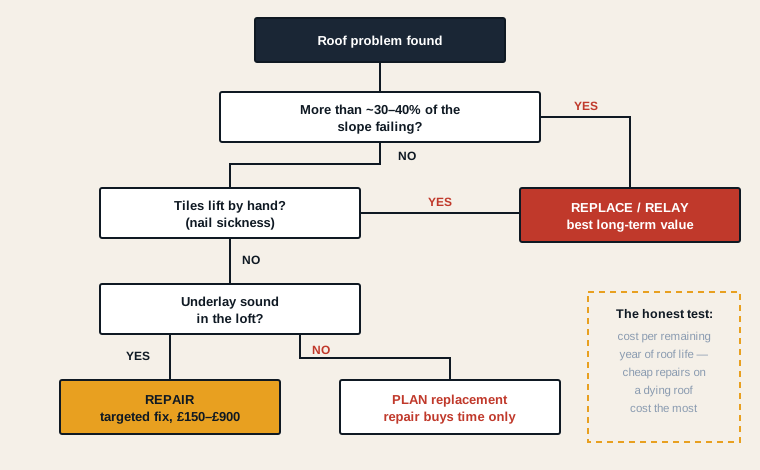
The useful question is not “what does it cost” but “what does each option cost per year of roof it buys.” A £350 valley repair that gives a fundamentally sound roof another 15 years costs about £23 a year — exceptional value. The same £350 on a nail-sick slope that will shed another course each winter buys perhaps 18 months: £230 a year, and you will spend it again. Meanwhile a £8,000 re-roof on that same failing slope, giving 50+ years at BS 5534 fixing standards, runs £160 a year and ends the cycle. Cheap repairs on a dying roof are the most expensive roofing money you can spend.
When patching is money wasted
Three patterns mean stop patching. First, confirmed nail sickness — if tiles or slates lift by hand because the fixings have rusted through, every repair is temporary by definition; the fault is under every tile, not just the slipped ones. Second, recurring repairs on the same slope — paying twice for the same elevation in three years is the roof telling you something. Third, failed underfelt across the roof — brittle, torn 1960s–70s bitumen felt visible from the loft means the secondary defence is gone, and no amount of tile-level tinkering restores it.
When replacement is oversell — and how to spot it
Equally: be suspicious of a replacement quote for a localised symptom. One damp patch does not condemn a roof. A single slipped course after a storm is a repair. Moss is maintenance, not failure. “While we’re up here we found…” without photographs is a red flag, and so is any diagnosis delivered from the kerb without anyone touching the roof. Ask for photos of the specific defects, ask what percentage of the covering is affected, and ask the cost-per-year question above — an honest roofer answers all three without flinching. Our choosing a roofer guide lists the rest of the tells.
The middle paths people forget
Repair-or-replace is not always binary. A partial re-roof — one failed slope done properly while sound slopes are left alone — is often the right answer on older houses where sun and weather have aged elevations unevenly. A strip-and-relay reusing your original slate or clay with new fixings and membrane keeps a period roof’s appearance (and satisfies conservation expectations near the Causeway) at meaningfully less than new-material cost. And planned replacement — surveying now, budgeting, and choosing your moment in two or three years rather than being forced by a winter failure — turns the biggest-ticket job in home maintenance into a decision instead of an emergency.
What we will actually tell you
Our survey ends with a graded, photographed answer: fix now, plan for, or monitor — with costs against each. If it is a £220 repair, that is the recommendation, and the re-roof conversation waits until the roof genuinely asks for it. If it is systemic, we show you the evidence and price both the honest holding repair and the replacement so the decision — and its timing — is yours. See roof repairs and new roof costs for the numbers either way.
One final rule of thumb worth keeping: get the survey before the sales pitch. A photographed condition report costs at most a couple of hundred pounds — often nothing — and it converts the biggest maintenance decision your house will face from guesswork into arithmetic you can check.