Chimney repointing across Horsham with era-correct mortar — repointing, flaunching, cowls and capping. Lime on period stacks, matched joints, 10-year guarantee.
Tell us the job in 30 seconds. No pushy sales, no call-out fee.
📞 Call Now: 0140 358 1272The chimney stack is the most exposed masonry on any house — it stands proud of the roof, takes weather from every direction, and is the first thing to suffer when mortar ages. Across Horsham’s Victorian and Edwardian terraces near the town centre and Denne Road, and on the 1930s semis, stacks built in lime mortar have often gone decades without attention. The prevailing south-westerlies drive rain into the windward face, eroding the joints until water penetrates, the stack starts to lean, and damp appears in the bedrooms below. Repointing renews the joints before that happens. On the post-war estates the stacks are cement-mortar and later, but ridge-line exposure means they still need periodic attention.
| Work | Typical Cost | Notes |
|---|---|---|
| Chimney repointing (per stack) | £300–£700 | Scope and access dependent |
| Flaunching renewal | £200–£400 | Mortar bed that seats the pots |
| Cowl / cap fitting | £80–£250 | Per pot; anti-downdraught or capping |
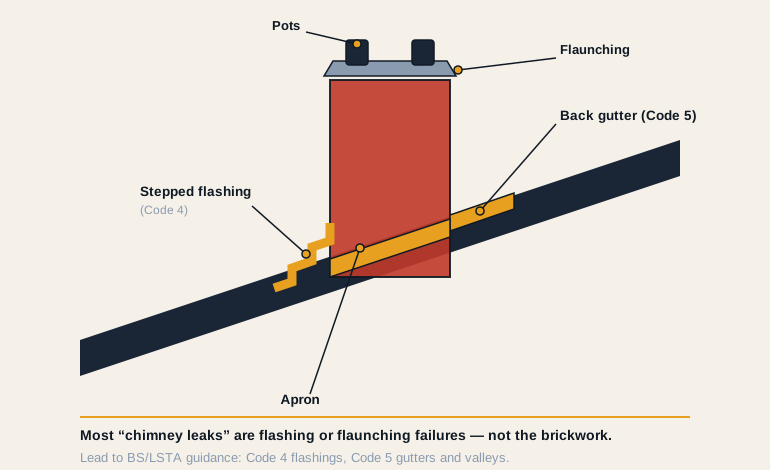
| Full lead flashing set | £400–£900 | Step flashing, back gutter, soakers |
| Partial stack rebuild | £600–£1,500 | Where mortar failure is advanced |
Using the wrong mortar does more harm than good. On pre-1930 Horsham stacks — the Victorian terraces and older village properties — the correct specification is a hydraulic lime mortar (NHL 3.5) that flexes with the masonry and lets it breathe. Hard cement pointing on soft historic brick traps moisture and spalls the brick faces over time. On post-war stacks a cement mortar is appropriate. We rake out the failed joints to a proper depth, repoint in the matching mortar and finish the joint to match the original, then renew the flaunching and check the flashings while the access is there. A stack is a whole system — pointing, flaunching, pots and flashings all keep water out together.
Building Regulations require chimneys to be structurally sound and weathertight; repointing and flaunching are the routine maintenance that keeps a stack compliant and safe. — Building Regulations / NFRC guidance
The warning signs of a failing stack are visible from the ground if you know what to look for: crumbling or missing mortar between the bricks, white staining (efflorescence) on the stack, a lean developing away from vertical, cracked or missing flaunching around the pots, and damp patches on the chimney breast in the bedrooms or loft. Vegetation growing on the stack is a sure sign the mortar has failed enough to hold moisture and seed. On Horsham’s exposed stacks the windward, south-westerly face always goes first. Left too long, a leaning or badly eroded stack becomes a safety issue and a partial rebuild rather than a repoint — which is why catching it at the pointing stage saves money.
Every job follows a free survey with no call-out fee. We attend survey requests within 3–5 working days and reach emergencies within 2–4 hours, and you receive a written, itemised, fixed-price quote before any work starts. We are NFRC registered with £5 million public liability insurance, and all work carries a written 10-year workmanship guarantee. We cover Horsham, Southwater, Billingshurst, Pulborough, Storrington and Henfield, plus the Horsham neighbourhoods of Roffey, Broadbridge Heath, Littlehaven, North Heath, Holbrook and Southgate — no travel premium. Call 0140 358 1272.
A surprising amount of the internal damp we’re called to in Horsham traces back to the chimney rather than the main roof. Eroded pointing lets rain soak into the stack, which then shows as damp patches on the chimney breast in bedrooms and lofts, often mistaken for a roof leak. Failed flaunching lets water past the pots and down the flue. Missing or cracked flashings at the base of the stack channel water straight into the roof space. Because the stack is a system, fixing one part without the others rarely solves the damp — which is why we assess pointing, flaunching, pots and flashings together and quote the work that actually stops the water, not just the most visible symptom.
Chimneys fail from the top down, and most of it is invisible from the ground until water is already inside.
When it is not the answer: If the stack is redundant and badly gone, honest advice is sometimes to reduce and cap it rather than pay to rebuild masonry you never use - we price both routes so you can decide. Read the full guide.
Close inspection at height - pointing, flaunching, pots, lead, and the stack’s lean if any - with photos you can actually see.
Repointing spec matched to the stack’s age: lime mortar on pre-1930 masonry, never hard cement that spalls old brick.
Chimney scaffold or tower with a working platform - stack work is never done off a ladder.
Joints raked and repointed, flaunching recast, pots re-bedded or capped, lead renewed in Code 4/5 as the detail demands.
Platform down, photos of the finished stack, guarantee handed over.
| Job | Typical duration |
|---|---|
| Repoint a single stack | 1-2 days |
| Reflaunch & re-bed pots | 1 day |
| Lead flashing renewal | 1 day |
| Partial rebuild (top courses) | 2-3 days |
| Reduce & cap redundant stack | 1-2 days |
Lime mortar needs mild, damp-but-not-wet conditions to cure - hard frost or driving rain moves the date, and we protect fresh work overnight.
Stack work always gets a proper platform - chimney scaffold on the roof slope or a tower to the eaves with a stack platform above. Scaffold is specified for: all chimney work above gutter height - it is the one place we never compromise on access - always itemised in your written quote, never a hidden extra, and we arrange it.
The Causeway and Denne Road conservation streets take footway scaffold licences with conservation conditions, while the Victorian terraces off Park Street and New Street often need rear-lane tower access rather than front scaffold. Pavement scaffold and skip permits go through Horsham District Council; allow a few working days on streets like The Causeway, East Street, Park Street where space is tight.
| Job | Typical range | Notes |
|---|---|---|
| Repoint single stack | £450-£900 | Lime on pre-1930 masonry |
| Reflaunch & re-bed pots | £250-£500 | Incl. new flaunching |
| Lead flashing renewal | £350-£650 | Code 4/5 |
| Partial rebuild (top courses) | £800-£1,600 | Matching brick |
| Reduce & cap redundant stack | £600-£1,200 | Vented cap |
Worked example: A Victorian stack off Hurst Road: raked and repointed in NHL 3.5 lime with recast flaunching and two pots re-bedded, £780 including platform, over two days.
Most stack jobs payable on completion; rebuilds staged. Never money up front before materials and access are on site.
Covering RH12, RH13 and surrounding postcodes.
Repointing and flaunching carry the 10-year workmanship guarantee; on lime work we also tell you honestly that historic stacks weather - the guarantee covers our joints, not century-old brick faces.
If a fault appears in covered work, we come back and put it right. No quibbling, no re-charge.
A chimney platform above your roof for a few days, some mortar noise, and dust sheets in the fireplace room if pots come off - swept and cleared after. You do not need to stay home for external work - we just need power and access agreed in advance.
Fresh lime pointing gets hessian or sheeting protection against frost and rain until it has taken - we build that into the programme. Horsham sits in the damp Low Weald, so autumn drying times run slow and moss pressure is constant on north pitches.
"Repointed our Victorian stack in lime mortar and matched it beautifully. Damp patch in the bedroom gone."
"New flaunching and a cowl on the unused flue. Explained exactly what was needed and why. No upsell."
"Stack was letting water in. They repointed and sorted the flashings in the same visit. Proper job, guaranteed."
Repointing a chimney stack costs £300–£700 depending on height, access and the number of faces, with flaunching renewal £200–£400, cowls £80–£250 per pot, a full lead flashing set £400–£900, and partial stack rebuilds £600–£1,500. Access is the main variable — a stack reachable from a roof ladder costs less than one needing scaffold. Because a chimney is a system, we assess pointing, flaunching, pots and flashings together and itemise each, so you can see exactly what the stack needs rather than paying for a vague ‘chimney repair’.
It depends on the age of the stack. Pre-1930 stacks — the Victorian terraces near the town centre and Denne Road, and older village properties — need a natural hydraulic lime mortar (typically NHL 3.5) that flexes and breathes with the soft historic brick. Post-war stacks take a cement mortar. Using hard cement on soft historic brick is a common and damaging mistake: it traps moisture and spalls the brick faces over a few winters, causing far more harm than the original worn pointing. We match the mortar to the era, and the joint finish to the original. See pointing in our glossary.
Flaunching is the sloping bed of mortar on top of the chimney stack that seats the pots and sheds rainwater away from them. It’s one of the most exposed pieces of mortar on the whole building, and cracked or missing flaunching is a very common cause of chimney leaks — water gets past the pots and runs down inside the stack and flue. We renew flaunching as part of repointing work, using the correct mortar for the stack’s age, so the top of the chimney sheds water properly again. It’s often the real cause when damp appears on a chimney breast.
A cowl helps in specific situations: where you get downdraught blowing smoke back into the room, where birds nest in an open pot, or where you want to cap an unused flue while keeping it ventilated to prevent damp. Not every chimney needs one, and fitting the wrong type can cause problems, so we advise on whether you’d benefit and which cowl suits during the survey. Capping an unused flue is particularly worth doing properly — sealing it completely without ventilation traps moisture and causes damp, which is why a ventilated cap is usually the right answer.
We access the stack from scaffold or a secured roof ladder depending on the pitch and position, inspect all four faces plus the flaunching and flashings, and photograph the condition so you can see what needs doing before we start. Chimney work is inherently high and exposed, so safe access is the first consideration — it’s not work to attempt off a ladder propped against the stack. Proper access also lets us do the job thoroughly: repoint every face, renew the flaunching, and check the flashings in one visit rather than missing the side you can’t easily reach.
Yes — conservation-area and listed stacks are repointed in matching lime mortar with a joint finish that matches the original, keeping the work sympathetic and compliant. On a listed building, work affecting the chimney can require listed building consent, and we advise on what’s needed and liaise with Horsham District Council before starting controlled work. Getting the mortar and finish right on a historic stack matters as much as on the roof itself — a chimney repointed in hard grey cement stands out and damages the brick. Our heritage roofing page covers conservation stacks in detail.
If the mortar has failed but the brickwork itself is sound, repointing is enough and far cheaper. Where the bricks are cracked, spalled or frost-damaged, or the stack has started to lean, a partial rebuild is the safer investment — repointing a structurally failing stack just delays the inevitable. We give an honest assessment at survey based on the actual condition of the brick, not just the mortar. A leaning or badly spalled stack is also a safety issue, since falling masonry is a real risk, so it’s not something to leave once it’s reached that point.
Repointing in the correct mortar lasts decades — lime on period stacks and cement on post-war stacks both give long service when the joints are raked out to a proper depth and finished correctly. The failures that lead to early re-repointing are almost always down to the wrong mortar (hard cement on soft brick) or shallow, cosmetic pointing that doesn’t key into the joint. Done properly, on a sound stack, repointing is a long-term fix rather than a recurring job. That’s why we rake out to depth and match the mortar to the brick rather than smearing new mortar over the old.
Yes — we can cap an unused flue while keeping it ventilated to prevent damp, or advise on removing a redundant stack where it’s failing and no longer serves any purpose. Capping is usually the better option: it stops rain entering the flue while ventilation prevents the trapped-moisture damp that fully sealing a flue causes. Removing a stack is more involved — it affects the roofline and needs making good — but can make sense where a stack is beyond economic repair. We’ll set out the options honestly rather than pushing the bigger job.
Yes — we match the mortar colour and the joint finish to the existing stack so the repointing blends in rather than standing out, which matters especially on period and conservation properties where a mismatched repair looks worse than the original worn pointing. On older Horsham stacks that means lime mortar tinted and finished to match the weathered original; on post-war stacks, matching the cement colour and profile. Getting the match right is part of doing the job properly — a well-repointed stack should look like it was always that way, not like it’s been patched.
No call-out fees. No obligation. Just an honest quote from a local Horsham roofer who turns up when they say they will.
0140 358 1272