Chimney repointing, lead flashing, pot replacement and stack repairs in Billingshurst. Correct mortar specification for every property type.
Tell us the job in 30 seconds. No pushy sales, no call-out fee.
📞 Call Now: 0140 358 1272Chimney repair calls from Billingshurst are driven primarily by the age and exposure of local properties. mixed stock from period cottages on the High Street to 1960s–80s concrete tile estates means a mix of original lime mortar stacks and later OPC repoints — some of which used the wrong mortar specification and are now causing spalling. relatively exposed position on low ground near the Arun watershed, driving rain accelerates mortar degradation on chimneys accelerates mortar degradation on exposed stacks, meaning Billingshurst chimneys typically need attention more frequently than sheltered Horsham town centre properties.
The roofing challenges in Billingshurst are shaped by two factors: mixed stock from period cottages on the High Street to 1960s–80s concrete tile estates, and relatively exposed position on low ground near the Arun watershed, driving rain accelerates mortar degradation on chimneys. The most frequent repair and replacement calls we receive from High Street, Station Road, the southern growth estates reflect these conditions directly — chimney mortar failure on exposed period properties, concrete tile nail sickness on post-war estates, and dormer flashing failure on loft conversions. We account for these when surveying and specifying work in Billingshurst, rather than applying a generic approach.
We access every chimney from roof level — not just from the ground with binoculars — and photograph the full condition before advising. Repointing is specified with the correct mortar type for the construction: hydraulic lime NHL 3.5 or 5 for pre-1945 masonry, OPC-based mortar for post-war stacks. Lead flashing is replaced with code-weight sheet lead and correctly stepped and wedged, not simply resealed with mastic.
📞 Free Chimney Repairs Survey — Billingshurst — Call 0140 358 1272 to arrange a no-obligation survey. We cover Billingshurst and all of West Sussex.
Typical cost: £250–£1,200 depending on scope. All quotes are written, itemised and fixed — no hidden extras added after the survey. We provide free quotes for all chimney repairs work in Billingshurst.
Book a Free Chimney Survey — 0140 358 1272Based in Horsham, covering Billingshurst and all of West Sussex. Not a national franchise farming out to subcontractors.
No call-out fee to visit Billingshurst. We inspect, photograph and provide a written quote — no obligation to proceed.
Written workmanship guarantee on all chimney repairs work. We stand behind every job.
Full NFRC membership and £5m public liability insurance. You're fully protected on every job.
"Thorough survey, honest quote and clean work. They know what they're doing on West Sussex roofs — the advice on materials was spot on for my property."
"Called about chimney repairs and they were with us within the week. Explained everything clearly before starting, no surprises on the invoice."
"Used for chimney repairs after a recommendation from a neighbour. Competitive quote, turned up on time, excellent finish. Would use again."
Yes. Billingshurst is within our regular working area from Horsham — typically 10–20 minutes depending on traffic. We cover all of West Sussex for chimney repairs and attend Billingshurst jobs most weeks. Call 0140 358 1272 for a free survey or quote.
Pricing starts from £250. £250–£1,200 depending on scope. We provide free, written, itemised quotes for all work in Billingshurst — call 0140 358 1272 or request a survey online.
The most frequent issues we see in Billingshurst are chimney mortar failure on exposed period properties, concrete tile nail sickness on post-war estates, and dormer flashing failure on loft conversions. These are driven by the local housing stock — predominantly mixed stock from period cottages on the High Street to 1960s–80s concrete tile estates — and the local climate: relatively exposed position on low ground near the Arun watershed, driving rain accelerates mortar degradation on chimneys.
For emergencies we aim to reach Billingshurst within 2–4 hours. For standard surveys and quotes we typically schedule within 3–5 working days. Call 0140 358 1272 to check current availability.
Signs visible from the ground include mortar gaps between brick courses, loose or displaced flaunching around the chimney pots, staining on the chimney breast inside, or damp patches on the ceiling near the chimney. A closer inspection from roof level will confirm the extent. We carry out free chimney surveys.
Pre-1945 masonry requires hydraulic lime mortar. Using OPC cement mortar on older brickwork causes spalling as the rigid mortar prevents movement. Post-war concrete block chimneys can be repointed with standard OPC mortar. We specify the correct type for your property as standard.
Correctly specified and applied chimney repointing typically lasts 20-30 years on a sheltered stack and 10-20 years on an exposed stack. Using the wrong mortar specification can reduce this dramatically. Our repointing is guaranteed for 10 years from completion.
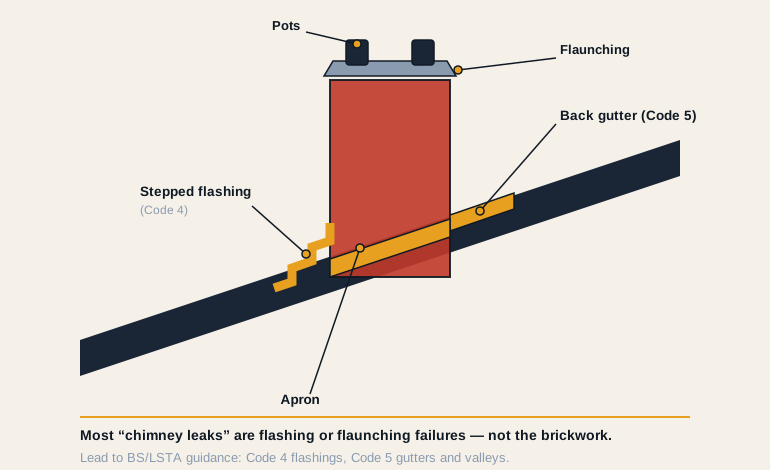
Chimneys fail from the top down, and most of it is invisible from the ground until water is already inside.
When it is not the answer: If the stack is redundant and badly gone, honest advice is sometimes to reduce and cap it rather than pay to rebuild masonry you never use - we price both routes so you can decide. Read the full guide.
Billingshurst's position on low ground near the Arun watershed makes it one of the more exposed satellite towns we cover. The town sits without the natural wind shelter provided by the South Downs to towns further east, and driving rain from the south-west accelerates mortar degradation on exposed chimney stacks and ridge lines. Properties on the High Street and immediately surrounding streets experience the highest levels of mortar erosion we see in the area.
Billingshurst has a genuinely mixed housing stock: period clay tile and natural slate cottages on the historic High Street and Station Road, post-war concrete tile semis on the surrounding residential streets, and 1980s–90s growth on the southern and western fringes. The High Street conservation area imposes material constraints — clay plain tile or natural slate is the appropriate specification for period properties, and we source matching reclaimed material where needed.
For Billingshurst's period High Street properties we work with reclaimed clay tile suppliers and specify hydraulic lime mortar for chimney and ridge pointing. For the post-war estate stock we carry the most common concrete tile profiles used in the area and standard OPC mortar. Response time from survey to completion is typically 5–10 working days for repairs, with re-roofs typically programmed within 3–4 weeks of survey.
Close inspection at height - pointing, flaunching, pots, lead, and the stack’s lean if any - with photos you can actually see.
Repointing spec matched to the stack’s age: lime mortar on pre-1930 masonry, never hard cement that spalls old brick.
Chimney scaffold or tower with a working platform - stack work is never done off a ladder.
Joints raked and repointed, flaunching recast, pots re-bedded or capped, lead renewed in Code 4/5 as the detail demands.
Platform down, photos of the finished stack, guarantee handed over.
| Job | Typical duration |
|---|---|
| Repoint a single stack | 1-2 days |
| Reflaunch & re-bed pots | 1 day |
| Lead flashing renewal | 1 day |
| Partial rebuild (top courses) | 2-3 days |
| Reduce & cap redundant stack | 1-2 days |
Lime mortar needs mild, damp-but-not-wet conditions to cure - hard frost or driving rain moves the date, and we protect fresh work overnight.
Stack work always gets a proper platform - chimney scaffold on the roof slope or a tower to the eaves with a stack platform above. Scaffold is specified for: all chimney work above gutter height - it is the one place we never compromise on access - always itemised in your written quote, never a hidden extra, and we arrange it.
The A29 High Street frontages need traffic-managed scaffold licences from the county highways team via the district council, and parking suspensions book up fast; estate roads off Newbridge Road are straightforward driveway jobs. Pavement scaffold and skip permits go through Horsham District Council; allow a few working days on streets like High Street, East Street where space is tight.
| Job | Typical range | Notes |
|---|---|---|
| Repoint single stack | £450-£900 | Lime on pre-1930 masonry |
| Reflaunch & re-bed pots | £250-£500 | Incl. new flaunching |
| Lead flashing renewal | £350-£650 | Code 4/5 |
| Partial rebuild (top courses) | £800-£1,600 | Matching brick |
| Reduce & cap redundant stack | £600-£1,200 | Vented cap |
Worked example: A Victorian stack off Hurst Road: raked and repointed in NHL 3.5 lime with recast flaunching and two pots re-bedded, £780 including platform, over two days.
Most stack jobs payable on completion; rebuilds staged. Never money up front before materials and access are on site.
Covering RH14 and surrounding postcodes.
Repointing and flaunching carry the 10-year workmanship guarantee; on lime work we also tell you honestly that historic stacks weather - the guarantee covers our joints, not century-old brick faces.
If a fault appears in covered work, we come back and put it right. No quibbling, no re-charge.
A chimney platform above your roof for a few days, some mortar noise, and dust sheets in the fireplace room if pots come off - swept and cleared after. You do not need to stay home for external work - we just need power and access agreed in advance.
Fresh lime pointing gets hessian or sheeting protection against frost and rain until it has taken - we build that into the programme. Low Weald clay holds moisture, so gutters and valleys silt quickly under the mature oaks that line the older plots.
West Sussex's Low Weald position creates persistent damp conditions through autumn and winter that accelerate moss growth, lead corrosion and organic roof material decay compared to drier UK regions. We specify and maintain with this in mind.
West Sussex has more housing diversity per square mile than most English counties — Georgian, Victorian, 1930s, post-war and modern estates all within short distances of each other. Each requires different materials and techniques.
Horsham district has multiple conservation areas with specific material requirements. Getting the specification wrong on a conservation area property can mean enforcement action. We know which areas have which requirements.
Towns at the foot of the South Downs — Storrington, Steyning, Henfield — experience significantly higher wind loading than sheltered Weald towns. We adjust our fixing specifications for exposure zone as standard.
No call-out fee. No obligation. Free written quote for chimney repairs in Billingshurst.
0140 358 1272 About Horsham Roofing Experts